

Kentucky State Researchers Develop Sustainable Strategies for Indoor Crop Production
National conference presentations highlight practical approaches to conserving water, recycling nutrients, and supporting growers
FRANKFORT, Ky. — In indoor agriculture, every drop of water, dose of fertilizer, and hour under specialized lighting can affect productivity, cost, and environmental impact. Kentucky State University faculty and graduate researchers are studying how growers can manage those resources more precisely.
Dr. Milon Chowdhury, assistant professor of biological and agricultural engineering, and graduate research assistant Rubel Reza recently represented Kentucky State’s Controlled Environment Agriculture Technology Lab at two national conferences. Their presentations highlighted applied research in water conservation, crop production, and nutrient recycling.
 One project, presented by Dr. Chowdhury during the 2026 American Society of Agricultural
and Biological Engineers Annual International Meeting, examined how moisture sensors
can improve irrigation for tomatoes grown in Dutch bucket hydroponic systems.
One project, presented by Dr. Chowdhury during the 2026 American Society of Agricultural
and Biological Engineers Annual International Meeting, examined how moisture sensors
can improve irrigation for tomatoes grown in Dutch bucket hydroponic systems.
Combining sensor-based irrigation with an optimized growing substrate could substantially reduce water and nutrient use, the study found. Rather than irrigating on a fixed schedule or according to the amount of water draining from a container, the system supplies water based on the substrate’s actual moisture level. For greenhouse growers, this could offer a more precise, automated, and labor-saving way to manage irrigation while maintaining crop productivity.
A second study, presented at the 2026 American Society for Horticultural Science Annual Meeting, explored how organic fertilizer, growing substrate, and light spectrum interact to influence microgreen production. The findings could help growers maintain crop quality and performance while reducing reliance on synthetic inputs.
 Reza, who is pursuing a Master of Science in Environmental Science and Technology, presented his work on recovering nutrients from organic waste through anaerobic
digestion for use in liquid organic fertilizer. The approach could reduce agricultural
waste, lower dependence on synthetic fertilizers, and return valuable nutrients to
crop production. A $500 travel award, which Reza also received the previous year, supported his participation in the meeting.
Reza, who is pursuing a Master of Science in Environmental Science and Technology, presented his work on recovering nutrients from organic waste through anaerobic
digestion for use in liquid organic fertilizer. The approach could reduce agricultural
waste, lower dependence on synthetic fertilizers, and return valuable nutrients to
crop production. A $500 travel award, which Reza also received the previous year, supported his participation in the meeting.
Beyond presenting his research, Dr. Chowdhury moderated and judged presentations in the Controlled Environment Production and Systems session, evaluated entries in the Extension Education Materials Competition, and served on the ASHS Mechanization, Robotics and Smart Tech Publication Awards Committee.
His leadership within ASHS extends to the Tropical Horticultural Crops Interest Group. After serving as secretary for 2025–26, Dr. Chowdhury will serve as chair-elect for 2026–27. The group brings together researchers studying the production, postharvest handling, and processing of tropical and underused horticultural crops, creating opportunities for collaboration across a wide range of specialty crops.
Across both meetings, Dr. Chowdhury and Reza connected with researchers and industry professionals from across the United States and beyond. Their conversations explored potential collaborations in controlled environment agriculture, automation, nutrient recovery and management, and sustainable crop production that could expand research and educational opportunities at Kentucky State.
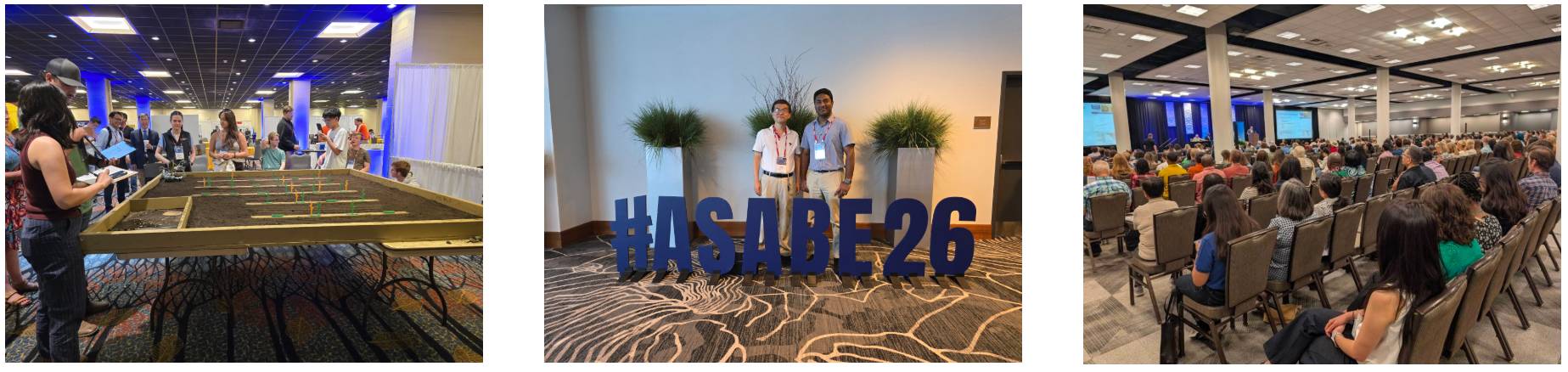
“These conferences provide an excellent opportunity to showcase the innovative research being conducted at Kentucky State University while building partnerships that can expand our research and educational opportunities,” Dr. Chowdhury said. “Our work focuses on developing practical technologies and management strategies that can help resource-limited growers produce crops more efficiently while conserving water, nutrients, energy, and other resources.”
At Kentucky State, Dr. Chowdhury holds a joint appointment spanning the College of Agriculture, Health, and Natural Resources and the College of Business, Engineering, and Technology. His appointment reflects the interdisciplinary structure of the biological and agricultural engineering program, launched in fall 2025 through a partnership between the two colleges and offering undergraduate and graduate study.
The liquid organic fertilizer research was supported through the U.S. Department of Agriculture’s National Institute of Food and Agriculture Evans-Allen Program under the project “Innovative Production and Evaluation of Liquid Organic Fertilizer for Sustainable Hydroponic Practices” (accession No. 7009119; project No. KYX-102586P).
Legal Disclaimer:
EIN Presswire provides this news content "as is" without warranty of any kind. We do not accept any responsibility or liability for the accuracy, content, images, videos, licenses, completeness, legality, or reliability of the information contained in this article. If you have any complaints or copyright issues related to this article, kindly contact the author above.
